Disclosure: This post contains affiliate links. That means if you click on a link and make a purchase, I may earn a small commission at no extra cost to you. I only recommend products that I personally use and love. Thank you so much for your support — it helps me keep this blog going!
I. My Personal Story: Finding My Lifeline
I want to start by sharing why I am so passionate about this. Six years ago, my life changed in a way I never expected. I was diagnosed with rheumatoid arthritis (RA) and fibromyalgia. Suddenly, the body I knew felt like an enemy. The pain was constant, and I couldn’t move the way I used to. I felt like I was losing who I was. I used to be active, but now I spent many days stuck in bed.
The hardest part wasn’t just the pain. It was the long wait. I had applied for SSDI (disability insurance), and the wait for my determination letter felt like it would never end. During those years of waiting and worrying about my future, I felt like I was in a “dark place.” I couldn’t work, and I felt like I didn’t have a purpose anymore. This is a common feeling when you acquire a disability. You mourn the loss of what you could once do. You grieve the old version of yourself, and that grief is real and it is hard.
That is when I found crochet. It became my lifeline. Even on the days when my joints were stiff and I had to stay in bed, I could still pick up my hook. Feeling that soft yarn between my fingers and seeing a beautiful project grow row by row helped me feel human again. It gave me a reason to get up and a way to tell the world, “I am still here, and I am still a maker.” If you are suffering like I did, I want you to know that there is a way to find joy again, even when things feel hopeless.
II. What Crochet Did for My Body and My Mind
I know what you might be thinking. You might be asking, “How can someone with painful, stiff joints do something like crochet?” That is a fair question, and I asked myself the same thing at first. But here is what I learned. Crochet does not have to be perfect to be helpful. You do not have to crochet fast, or for a long time, or even every single day. You just have to start.
For me, even holding the hook and making a few simple chain stitches gave me something to focus on besides the pain. Doctors have a word for this. They call it a “distraction technique.” What it really means is that when your brain is busy thinking about something you enjoy, it has less room to focus on the hurt. I am not saying crochet cured my pain. It did not. But it gave me a break from it, even if that break only lasted twenty minutes.
One thing that made a really big difference for me was switching to ergonomic crochet hooks. Regular crochet hooks are thin and hard, and gripping them for too long can make sore, stiff hands feel even worse. Ergonomic hooks are different because they have a thick, soft, cushioned handle that is much easier to hold. Instead of squeezing tight and straining your fingers and wrist, your hand can relax around the wider grip. I recommend Yarniss 20 Sizes Crochet Hooks 0.5mm-10mm, Ergonomic Crochet Hooks Set with Case for Arthritic Hands, affiliate link. When I made the switch, I noticed right away that I could crochet for longer without as much pain and fatigue in my hands. I wish someone had told me about them sooner! You can find ergonomic crochet hooks at most craft stores or online, and they come in lots of fun colors too. If you have rheumatoid arthritis, fibromyalgia, or any condition that makes your hands hurt or feel stiff, I really believe ergonomic hooks are worth every penny. They are one of the best little tools I have found for making crochet more comfortable and accessible on the hard days.
There was also something really important that happened in my mind. When I finished even a small project, like a little square or a simple dishcloth, I felt proud. That feeling of “I made this” was something I had not felt in a long time. My illness had taken away so many things I used to be good at. But crochet gave me something new to be good at. It gave me back a piece of my identity.
I also noticed that my hands felt a little better on the days I crocheted. The gentle, repeated movement helped keep my fingers from getting too stiff. Of course, I always listened to my body. On the really bad days, I rested. But on the medium days, the days when I could manage, picking up my hook was one of the best things I could do for myself.
III. You Do Not Have to Be Crafty to Start
One of the biggest things that almost stopped me from trying crochet was that I did not think I was a “crafty person.” I had never done anything like it before. I had two left hands, as my mom used to say. I watched a few videos online and my first attempts looked like a tangled mess. I laughed at myself more than once.
But that is the thing about crochet. It does not ask you to be perfect. It just asks you to show up. The very first stitch most people learn is called a chain stitch. It is simple. You pull a loop of yarn through another loop. That is it. Once you learn the chain, the rest starts to make sense, little by little.
I started with the cheapest supplies I could find. A simple plastic crochet hook and a skein of soft yarn from the dollar bin at my local craft store. I did not need anything fancy. I did not need a big space or a lot of energy. I just needed a few minutes and a willingness to try something new. If I could do it from my bed, propped up on pillows with a heating pad on my back, then I really believe anyone can do it.
My recommendation is to first learn how to crochet the easiest stitch, which is the ‘chain’ stitch. The chain stitch is the foundation of every crochet stitch there is; therefore, it’s imperative to learn, practice and master the chain stitch as your first objective.
II’ve created a tutorial where I show you step-by-step how to crochet the chain stitch, watch my video tutorial right here:Click here to watch! I walk you through every step slowly and clearly, and you can pause and rewind as many times as you need to.
IV. The Community That Changed Everything
Something else happened when I started crocheting that I did not expect. I found people. Real, kind, wonderful people who understood what it was like to live with chronic pain and still want to create beautiful things.
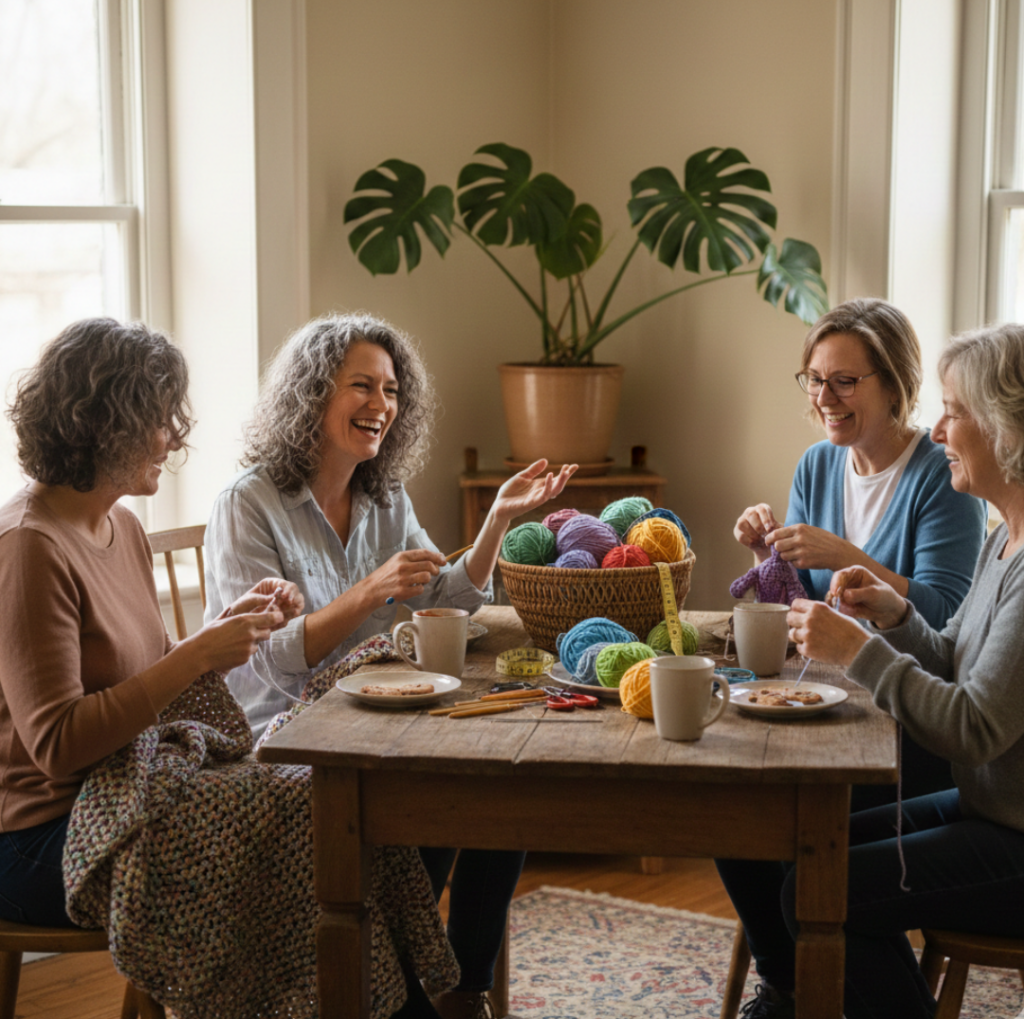
I joined a few online groups and forums for people who crochet. Some of these groups were even made up of people with chronic illnesses, just like me. Reading their stories made me feel so much less alone. They talked about adapting their crochet techniques for bad pain days. They shared patterns that were easy on the hands. They cheered each other on and celebrated every finished project, no matter how small.
Before my illness, I had a busy social life. I had coworkers and friends I saw every week. When I got sick and could not work anymore, a lot of that connection went away. The crochet community helped fill that hole in my heart. It reminded me that I was still a part of something. I still belonged somewhere.
If you are feeling isolated because of your illness or disability, I really encourage you to look for a crafting community. You can find them online on Facebook, Reddit, and Instagram. Many local libraries and community centers also have free crafting groups that meet in person. You do not have to go through this alone.
V. A Message to Anyone Who Is Struggling Right Now
If you are reading this and you are in that dark place that I talked about, I want you to hear me clearly. What you are feeling is real and it makes complete sense. Losing your health, your job, your routine, and your sense of who you are is one of the hardest things a person can go through. You are allowed to grieve that. You are allowed to have bad days and hard days and days when you cry and do not know why.
But I also want you to know that your story is not over. Not even close.
I would never have believed six years ago that I would be here today, writing a blog post and sharing my journey with other people. I would never have believed that I would find something that brought me so much joy. But I did. And I think you can too.
You do not have to start with crochet. Maybe your thing is drawing, or journaling, or listening to music, or learning a new language on your phone. The activity itself does not matter as much as the feeling it gives you, that feeling of “I am still me, and I am still here.”
Crochet just happened to be my lifeline. I hope that whatever yours is, you find it soon. And if you want to give crochet a try, I will be right here cheering you on, one stitch at a time.
Thank you for reading my story. If any part of this spoke to you, please feel free to share it with someone who might need it. And if you want to share your own story in the comments below, I would love to hear it.
